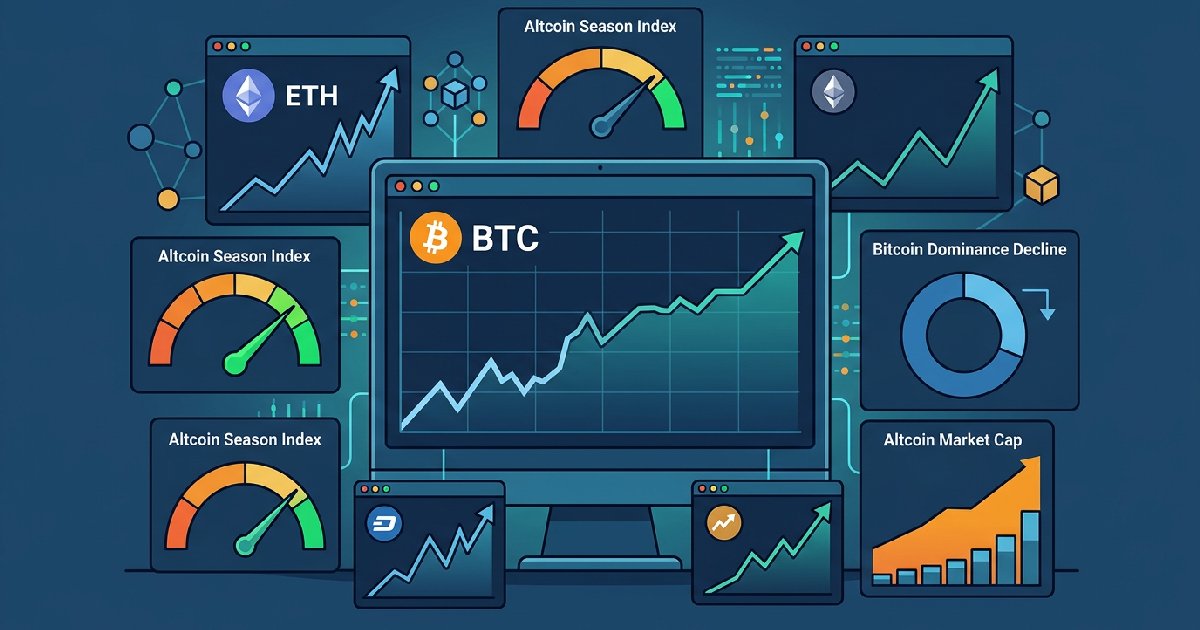
Identifying the Key Indicators That Signal an Altcoin Season is a primary focus for cryptocurrency investors as of June 13, 2026. This market phase occurs when alternative cryptocurrencies (altcoins) significantly outperform Bitcoin (BTC) over a sustained timeframe.
Specifically, an altcoin season is defined as a 90-day period where 75% or more of the top 50 or 100 cryptocurrencies outperform Bitcoin, excluding stablecoins and wrapped tokens. This shift signals a rotation of investor capital and sentiment away from the relative stability of the market leader and into the broader ecosystem.
The transition typically follows a structured movement of liquidity. As Bitcoin enters a period of consolidation, traders often seek higher returns in smaller-cap assets with greater growth potential. Monitoring these shifts requires a blend of technical metrics and market sentiment analysis. Without a combination of these indicators, a sudden price spike might merely represent temporary speculation rather than a sustainable market-wide trend.
The impact of Bitcoin dominance on market cycles
Bitcoin Dominance, often abbreviated as BTC.D, tracks the percentage of total cryptocurrency market capitalization held by Bitcoin. It remains one of the most vital Key Indicators That Signal an Altcoin Season. A decline in this metric, moving from levels above 50-60% toward 40% or lower, strongly indicates that capital is flowing into altcoins.
Analysis suggests that a confirmed break below the 54% threshold serves as a key inflection point for a broad altcoin recovery.
When Bitcoin’s market share falls, it reflects a growing appetite for risk among participants. Professional traders may be diversifying their holdings to capture the volatility of emerging projects. While Bitcoin provides a foundation for the market, its decreasing dominance allows the “altcoin” sector to expand its footprint. This expansion is often measurable through specialized tracking tools used by retail and institutional analysts alike.
Just as some analysts look for consistency in a fighter’s performance, as seen in the heavyweight title win for Oleksandr Usyk, crypto traders look for consistent trends in market share data. A steady decline in BTC.D is often the first domino to fall before a full season begins. Without this shift in market share, altcoin rallies often remain isolated to a few specific tokens.
Using the Altcoin Season Index for confirmation
The Altcoin Season Index (ASI) offers a mathematical approach to identifying these cycles on a scale from 0 to 100. This index, notably developed by Blockchaincenter, is also tracked by major platforms like CoinGlass and CoinMarketCap. It calculates the 90-day price performance of top-tier altcoins against Bitcoin to determine current market leadership.
An ASI reading between 75 and 100 confirms that an altcoin season is officially underway.
| Index Range | Market Phase | Market Behavior |
|---|---|---|
| 0–25 | Bitcoin Season | Bitcoin outperforms the majority of top altcoins. |
| 25–75 | Mixed Market | No clear dominance between Bitcoin and alternative tokens. |
| 75–100 | Altcoin Season | At least 75% of top altcoins outperform Bitcoin. |
Ethereum and the ETH/BTC ratio as market bridges
Ethereum (ETH) frequently acts as a bridge for capital moving out of Bitcoin and into more speculative altcoins. A strengthening ETH/BTC ratio, particularly a gain of 15-30%, often precedes a wider industry rally.
If Ethereum and other major competitors like Solana (SOL) fail to show strength against Bitcoin, high readings on other indices may be misleading. Traders use this ratio to gauge the health of the rotation.
Investors typically move capital from Bitcoin into Ethereum before exploring riskier opportunities in smaller tokens. This “waterfall” effect of liquidity is a hallmark of the Key Indicators That Signal an Altcoin Season. If this bridge remains weak, the market often sees only temporary speculation. This is why many high-stakes players watch the com/boxing-and-ufc-this-weekend-boxing-ufc-schedule-may-22-24-2026-correct/”>corrected market schedule and price data for signs of institutional movement into Ethereum.
Market capitalization expansion and trading volume
A true seasonal shift involves the total altcoin market capitalization expanding significantly faster than Bitcoin’s valuation. Ideally, this combined market cap should grow two to three times faster than Bitcoin over the same period.
Historical data highlights that during the May 2021 altcoin season, the combined cap of the top 100 altcoins reached approximately 130% of Bitcoin’s market cap. This indicates deep liquidity and widespread participation.
Current data is often sourced from Blockchaincenter to confirm whether price performance across the top 50 or 100 assets is truly broad-based. High trading volume and increased price volatility in alternative tokens are supplementary signs that the shift is happening. These factors ensure that price movements are backed by actual capital flows rather than just low-liquidity spikes.
Frequently Asked Questions
Does a rising Altcoin Season Index predict future gains?
The Altcoin Season Index is generally considered a confirmation tool rather than a leading indicator. By the time the index moves above 75, many of the significant entry points for the initial price surges may have already passed. It is used to confirm the sustainability of a move that has already begun.
Why is the ETH/BTC ratio so important for altcoins?
Ethereum is the largest altcoin by market cap and often leads the rest of the alternative market. When Ethereum gains value relative to Bitcoin, it signals that investors are ready to take on more risk. This sentiment usually trickles down to smaller-cap altcoins, fueling a broader market rally.
What happens to Bitcoin dominance during a market crash?
During market-wide corrections, Bitcoin dominance often increases as investors flee more volatile altcoins for the relative safety of Bitcoin. This “flight to safety” usually ends the altcoin season and restarts the Bitcoin-led phase of the market cycle until stability returns.