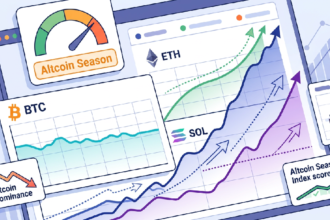
The cryptocurrency market, as of June 13, 2026, continues to operate in distinct cyclical phases where Bitcoin (BTC) and alternative assets trade momentum. An “altcoin season” occurs when non-Bitcoin digital assets collectively outperform the market leader, signaling a shift in investor appetite toward higher-risk opportunities.
This phenomenon typically surfaces once Bitcoin has completed a major price rally and enters a period of stabilization, allowing capital to rotate into different sectors of the digital economy.
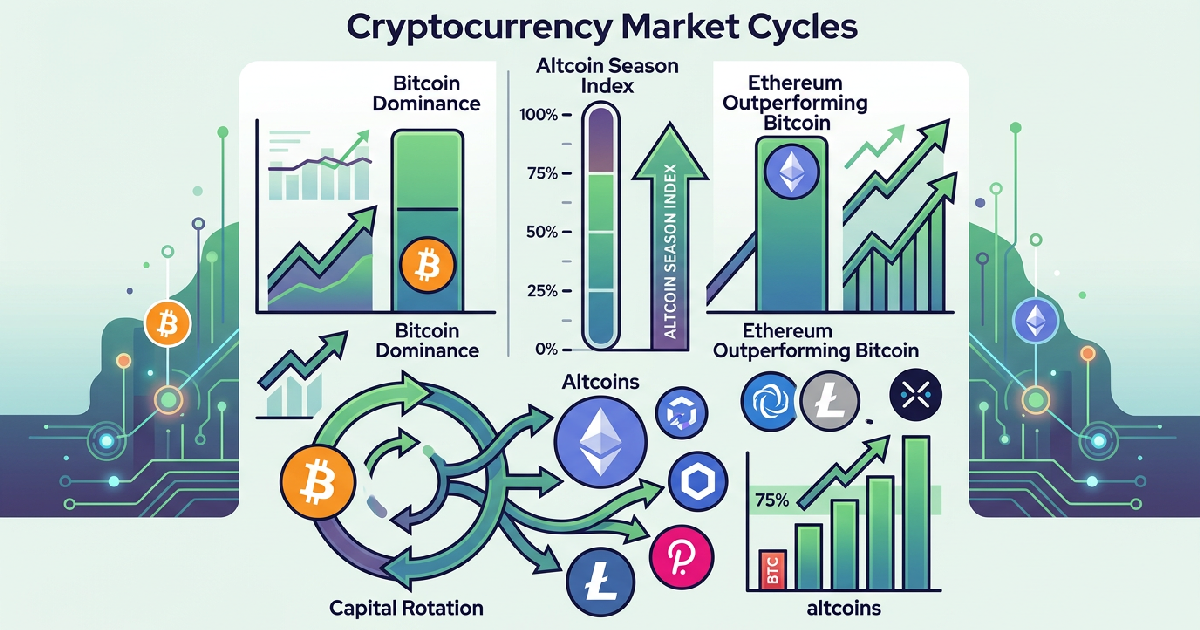
For a period to be officially classified as an altcoin season, the Altcoin Season Index generally requires that at least 75% of the leading altcoins outperform Bitcoin over a rolling 90-day window. This metric, provided by platforms like net/en/altcoin-season-index/”>Blockchaincenter, helps traders identify if the market is favoring the “digital gold” of Bitcoin or the broader ecosystem of alternative projects. When this threshold is met, it confirms that the focus of liquidity has moved beyond the primary asset.
Capital rotation is the primary engine behind these market shifts. It follows a logical progression of risk, starting with established assets and trickling down to more speculative ventures. Just as boxing fans might track a fighter’s stamina across rounds, crypto analysts track “Bitcoin Dominance” (BTC.D) to gauge market health.
A decline in this dominance score signals that funds are actively flowing out of Bitcoin and into altcoins.
The mechanics of capital rotation and market phases
The transition into an altcoin-heavy market does not happen instantly. It typically begins with Bitcoin breaking its previous all-time high, which draws fresh liquidity and mainstream attention into the sector. Once Bitcoin’s price begins to consolidate or move sideways, investors start seeking higher relative returns elsewhere. This search for yield drives the first wave of rotation into large-cap assets.
Ethereum (ETH) often serves as the “bellwether” for this transition. As the largest altcoin by market capitalization, its performance relative to Bitcoin is a key indicator of whether a broader season is imminent. When Ethereum begins to outperform Bitcoin, it signals a shift toward decentralized applications (dApps) and smart contract platforms. This phase often precedes the more volatile movements seen in mid-cap and small-cap projects.
Stages of the altcoin season progression
The progression of a typical season moves through four distinct stages. In Stage 1, Bitcoin leads the charge, but its dominance starts to fade as it reaches a plateau. This is followed by Stage 2, where Ethereum takes the lead. By Stage 3, large-cap altcoins often see significant value increases, sometimes ranging between 400% and 600% as the market gains confidence.
The final phase, known as the “Euphoria Phase” or Stage 4, involves low-liquidity, smaller projects. During this time, the market becomes highly speculative, and even obscure tokens can experience rapid price appreciation. Understanding these stages is as critical for participants as knowing the current schedule of major events in other high-stakes environments.
It allows for a more disciplined approach to profit-taking before the cycle inevitably resets.
Key metrics for identifying altcoin market shifts
Investors rely on several technical indicators to navigate these cycles. Quantitative data helps remove emotion from the trading process, which is especially important during the euphoria phase. Bitcoin Dominance remains the most scrutinized figure, as it represents Bitcoin’s share of the total market capitalization. When BTC.D falls while the total market cap stays steady, altcoins are gaining ground.
| Metric | Definition | Significance for Altcoin Season |
|---|---|---|
| Bitcoin Dominance (BTC.D) | BTC’s percentage of total crypto market cap | A declining percentage suggests capital rotation into alts. |
| Altcoin Season Index | 90-day rolling performance comparison | Confirmed when 75% of leading alts outperform BTC. |
| Total Market Cap (Ex-BTC) | Value of all crypto assets excluding Bitcoin | Growth here indicates fresh inflows into alternative projects. |
The term “altcoin” itself is a portmanteau of “alternative coin,” covering any cryptocurrency that is not Bitcoin. These assets were initially designed to improve upon Bitcoin’s perceived limitations, such as scalability or transaction speed. Today, they encompass everything from privacy-focused coins to governance tokens for decentralized finance (DeFi) protocols. Keeping track of these com/ryan-garcia-wbc-champion-face-of-boxing-updates/”>rising names in the industry is essential for anyone following the latest market developments.
Risks and institutional perspectives on altcoins
While the potential for high rewards is a major draw, altcoin season carries substantial risks. Many altcoins lack the deep liquidity of Bitcoin, meaning they are susceptible to extreme price swings from relatively small trades. The “Euphoria Phase” often sees projects with little fundamental value gain temporary traction, only to crash once the rotation cycle completes and capital flows back into safer assets.
There is also an ongoing debate regarding the classification of Ethereum. Due to its institutional adoption and the vast number of projects built upon its network, some argue it has moved beyond the “altcoin” label.
However, in the context of the Altcoin Season Index and general market terminology, it remains the primary driver of the alternative asset market. Its health is often a prerequisite for the success of smaller, more speculative ventures.
Ultimately, these seasons are a byproduct of the crypto market’s inherent volatility and the search for high-growth opportunities. They provide a window of time where the dominance of Bitcoin is challenged by a diverse array of technological experiments. As the market matures, these cycles may become more nuanced, but the underlying mechanic of capital rotation remains a fundamental characteristic of digital asset trading.
Frequently Asked Questions
What is the Altcoin Season Index?
The Altcoin Season Index is a technical indicator used to determine whether the market is currently in a Bitcoin-dominant or altcoin-dominant phase. It analyzes a rolling 90-day window and declares a “confirmed” altcoin season when at least 75% of the leading altcoins have outperformed Bitcoin during that period.
Why does Bitcoin usually rally before altcoins?
Bitcoin is often viewed as the “entry point” for new capital entering the cryptocurrency market due to its high liquidity and institutional status. When Bitcoin’s price stabilizes after a rally, investors often move their profits into higher-risk altcoins to seek further returns, creating the capital rotation effect that defines the season.
Are all non-Bitcoin cryptocurrencies altcoins?
By the standard definition, yes. The term “altcoin” refers to any cryptocurrency other than Bitcoin. This includes major assets like Ethereum, despite its large size and institutional use, as well as mid-cap utility tokens and small-cap speculative projects.