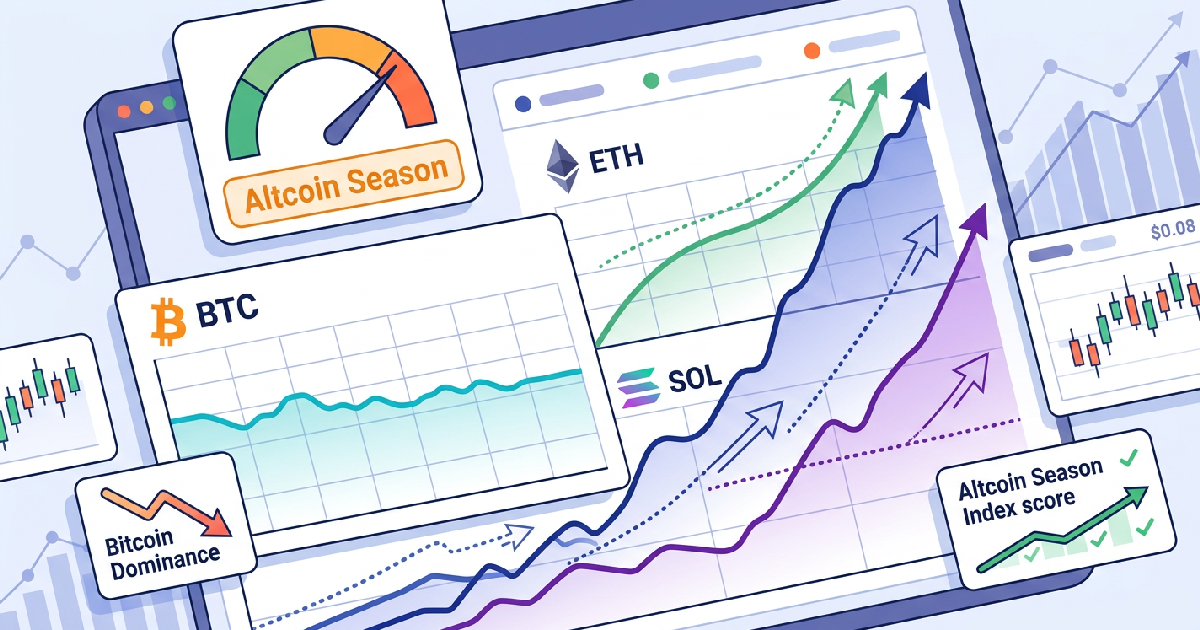
Altcoin season represents a specific market phase where alternative cryptocurrencies (altcoins) experience significant price appreciation and consistently outperform Bitcoin (BTC) over a sustained timeframe. This phenomenon usually emerges after Bitcoin has completed a substantial price rally and begins a period of stabilization.
As BTC prices level off, investors frequently reallocate their capital into other digital assets to seek higher returns, triggering a shift in market leadership.
The transition into an altcoin-dominated market is not instantaneous but rather follows a cyclical pattern of capital rotation. It typically begins in the middle to latter stages of a broader bull market when investor confidence is high.
Analysts and traders use specific metrics to track this movement, ensuring they can identify the flow of liquidity from the market leader into diverse projects like Ethereum (ETH), Solana (SOL), and Dogecoin (DOGE).
The five stages of the altcoin market cycle
The cryptocurrency market often adheres to a predictable rotation of capital that dictates how an altcoin season unfolds. This process begins with the Bitcoin Dominance Phase, where BTC prices rise significantly, attracting the bulk of market capital. During this initial climb, Bitcoin’s share of the total market capitalization increases, often leaving altcoins to underperform relative to the pioneer cryptocurrency.
Once Bitcoin’s price stabilizes, the second phase involves capital moving into major altcoins. Investors look toward large-cap assets like Ethereum or Binance Coin (BNB), which are perceived as safer diversification options. As these majors gain traction, the focus shifts to mid-cap altcoins supported by established communities and solid projects.
This can lead to the fourth phase, characterized by an explosion in low-cap and new altcoins, which offer the highest potential returns despite carrying the most risk.
The cycle eventually concludes with a return to Bitcoin dominance. After the market reaches a saturation point, capital typically rotates back into Bitcoin or stablecoins. This shift signals the end of the altcoin cycle as alternative assets begin to lose value against BTC. Historically, these full cycles have lasted between two and six months, often developing 18 to 30 months after a market bottom.
The role of the Bitcoin halving
The timing of these rallies is frequently linked to broader supply-side mechanics. Strong altcoin seasons have historically followed Bitcoin halving events, which reduce the rate of new BTC issuance. Once the market adjusts to the lower supply and Bitcoin establishes a new baseline, the resulting stability provides the necessary environment for capital to seek higher-beta opportunities in the altcoin ecosystem.
Key technical indicators of a shifting market
To determine if an altcoin season is underway, market participants monitor several primary data points. Bitcoin Dominance (BTC.D) is a critical metric representing Bitcoin’s percentage of the total market cap. A decline in dominance, typically from levels above 50-60% toward 40% or lower, suggests capital is actively flowing into altcoins. Conversely, rising dominance indicates a “risk-off” environment where investors prefer the relative safety of Bitcoin.
The Altcoin Season Index serves as a more direct benchmark for this transition. This tool, tracked by entities like Blockchaincenter, evaluates the performance of the top 50 or 100 cryptocurrencies by market cap against Bitcoin.
To qualify as a true altcoin season, 75% or more of these tracked assets must outperform Bitcoin over a rolling 90-day window. This specific percentage-based requirement provides a quantitative way to separate a temporary bounce from a sustained market shift.
Interpreting Altcoin Season Index scores
The index utilizes a scoring system from 0 to 100 to categorize the current state of the market. These scores allow traders to visualize capital flow and identify whether the environment favors Bitcoin or the broader altcoin market. While high scores indicate an altcoin-led phase, lower scores reflect Bitcoin’s strengthening grip on the total market value.
| Index Score | Market Classification | Key Characteristics |
|---|---|---|
| 0 – 25 | Bitcoin Season | BTC outperforms altcoins; rising BTC dominance. |
| 25 – 75 | Mixed Market | Fluctuating performance; neither BTC nor altcoins dominate. |
| 75 – 100 | Altcoin Season | 75%+ of top 50/100 altcoins beat BTC performance. |
Volume growth and social sentiment signals
Beyond dominance and index scores, trading volume and price volatility offer real-time insights into investor behavior. A week-over-week increase in altcoin-to-BTC trading volume of more than 50% is often a precursor to a major rally. This spike in activity indicates that interest is rising while Bitcoin’s price remains relatively stable.
Strong performance in benchmark pairs like ETH/BTC or SOL/BTC can further confirm that capital is moving deeper into the ecosystem.
Social activity also serves as a leading indicator. Data from Google Trends shows that a 30-50% increase in searches for phrases like “best altcoins” or “altcoin season” within a few weeks often aligns with impending market moves. When retail sentiment on social media turns positive alongside these search spikes, it reinforces the likelihood of a capital rotation into smaller assets.
And while these metrics are powerful, they are often used in conjunction with on-chain data. Growing stablecoin supplies and an increase in overall transactions typically indicate that liquidity is ready to be deployed. Much like the detailed planning seen in sports schedules, identifying a market trend requires looking at multiple data points together to ensure a clear picture of the upcoming activity.
Market capitalization expansion
For a full altcoin season to be confirmed, the total market value of all non-Bitcoin assets should expand significantly faster than Bitcoin’s itself. Ideally, this growth should occur two to three times faster than BTC over the same period. This aggressive expansion of the altcoin market cap is a hallmark of the low-cap and new altcoin explosion phase, where speculative capital is at its peak.
Impact on technological innovation and exchanges
Altcoin seasons do more than just drive price action; they provide the financial backing for technological growth. Increased capital flows can accelerate the development of new protocols, decentralized finance (DeFi) applications, and smart contract platforms.
This innovation cycle is essential for the long-term viability of the blockchain space, as it encourages developers to explore new consensus mechanisms like Proof of Stake or specific industry use cases.
Cryptocurrency exchanges also experience a significant impact during these high-volatility phases. The surge in trading volume for altcoins leads to enhanced liquidity and increased revenue opportunities from trading fees. However, the rapid price appreciation and speculative nature of these periods also result in heightened market volatility. This risk environment requires participants to utilize effective risk management and profit-taking strategies.
But the expansion of the market often forces infrastructure improvements. High transaction volumes can strain networks, leading to higher fees or slower confirmation times. As we saw during the debate over the impact of heavyweight results, the “heavyweights” of the crypto world like Ethereum often face intense scrutiny regarding their capacity to handle peak demand during these seasonal surges.
Common misconceptions regarding market timing
One prevalent myth is that altcoin season is a scheduled event with a “magical date” where all tokens rise together. In reality, the season is difficult to predict and unfolds in distinct phases. Not all altcoins will perform equally, and some may lose value even as others reach new highs.
The assumption that every Bitcoin bull run must lead to an altcoin season is also incorrect, as macroeconomic conditions and global liquidity levels play a decisive role.
Another misconception is the idea of guaranteed returns. While the ROI opportunities are often higher than Bitcoin, altcoins are generally more volatile and carry significantly more risk. Many projects lack real-world utility or may face liquidity issues that prevent investors from exiting positions. Maintaining a focus on fundamentals and project sustainability is crucial for avoiding losses when the cycle eventually rotates back to Bitcoin.
Frequently Asked Questions
What is the minimum requirement for the Altcoin Season Index?
An altcoin season is signaled when at least 75% of the top 50 or top 100 cryptocurrencies by market capitalization outperform Bitcoin. This performance is measured over a rolling 90-day period and excludes stablecoins and wrapped tokens from the calculation.
Which altcoins are typically used to gauge the start of a season?
Investors often watch “Major Altcoins” with high market caps, such as Ethereum (ETH) and Solana (SOL). Strong performance in the ETH/BTC or SOL/BTC trading pairs is frequently used as a benchmark to confirm that capital is flowing from the market leader into the broader ecosystem.
How long does the average altcoin rally last?
Historically, a full altcoin season typically lasts between two and six months. These rallies usually develop between 18 and 30 months after a Bitcoin market bottom, often appearing in the middle to latter stages of a broader market uptrend.
Strategic outlook for current market cycles
Identifying the onset of an altcoin season requires a disciplined approach to monitoring data rather than following hype. By following the 90-day performance of major assets and keeping a close eye on Bitcoin Dominance, traders can better understand the current market phase.
The transition from Bitcoin Season to a Mixed Market and eventually to Altcoin Season follows a path of capital rotation that has repeated in various forms throughout previous cycles.
As the market continues to evolve, the arrival of new projects and increased on-chain activity will likely keep this seasonal logic relevant. Whether driven by search trends, volume spikes, or technical indicators, the movement of capital remains the ultimate decider of market direction. Success in these periods depends on distinguishing between short-term price volatility and the genuine redistribution of liquidity across the digital asset landscape.