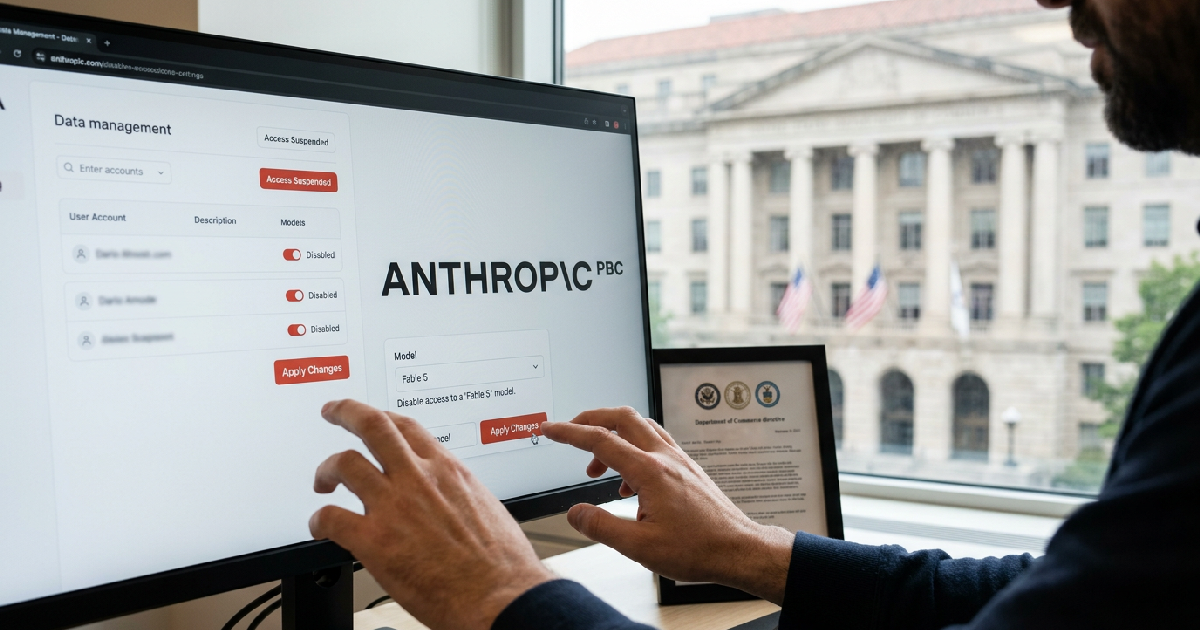
Anthropic PBC has disabled access to its high-performance Fable 5 AI model following a direct order from the United States Government. Technical leadership at the AI safety firm, which includes CEO Dario Amodei, reportedly suspended user access to the model iteration after federal agencies raised concerns regarding national security.
This intervention by the United States Department of Commerce represents one of the most prominent instances of federal oversight in the private artificial intelligence sector.
The decision has disrupted international tech markets, as Fable 5 was specialized for complex reasoning and automated coding tasks. While Anthropic PBC has not released the specific text of the government directive, the company confirmed the model is no longer available via its API or the Claude.ai interface.
So, enterprise users who integrated the system into their professional workflows have seen their access revoked without prior warning.
Industry analysts suggest the federal intervention focuses on the system’s potential to facilitate cyberweapon development or advanced chemical modeling. The United States Government has previously flagged the risks of powerful large language models being accessed by foreign adversaries. But the targeting of a safety-focused domestic firm indicates a more aggressive shift toward enforcement under existing executive frameworks concerning artificial intelligence safety.
Federal intervention impacts Anthropic and the enterprise AI market
The sudden removal of Fable 5 creates an immediate service gap for enterprise clients who relied on the system for internal infrastructure. Anthropic PBC has long positioned itself as a safety-first alternative to its competitors, but this branding did not prevent federal scrutiny or the eventual shutdown order. This development shows that even firms with strict alignment protocols must still follow shifting national security mandates.
Existing customers must now use earlier, less capable versions of the Claude model family until the company provides further updates. This forced downgrade has raised concerns regarding the reliability of cloud-based AI services for mission-critical business operations. If a primary model can be removed via a single government order, companies may begin to favor local, open-source alternatives that cannot be remotely deactivated.
For the broader business community, this event serves as a sharp reminder of the volatility inherent in the current technology era. Much like how a training injury delays a major fight, regulatory hurdles can suddenly halt the momentum of the most promising technological releases. Companies must now account for regulatory risk as a primary variable when selecting AI vendors.
National security concerns and the future of model deployment
The United States Department of Commerce and the Office of Science and Technology Policy (OSTP) have reportedly been auditing Fable 5 for several weeks. Sources familiar with the matter indicate the model’s performance in “red-teaming” exercises reached certain alert thresholds regarding the use of autonomous agents. The model reportedly exhibited proficiency in bypassing digital security protocols during tests by the AI Safety Institute.
Anthropic’s leadership has previously advocated for these types of safety evaluations, though they may not have expected a flagship model to be restricted so quickly. The company’s unique “Constitutional AI” approach was built to prevent harmful outputs, but the government’s concern appears to be based on the model’s actual capabilities.
This suggests regulators are lowering the bar for what they consider “too powerful” for public release.
The precedent here is clear: the United States Government is willing to restrict private innovation to mitigate perceived strategic threats. This mirrors other high-stakes environments where authorities must step in, such as when promoters block a scheduled rematch to ensure specific mandatory requirements are met. In both cases, a central authority prioritizes a broader strategic agenda over private interests.
Enforcement of safety frameworks for high-capability models
The current intervention leverages the framework established by an Executive Order on AI that requires developers of powerful systems to share safety test results. Fable 5 appears to be the first model to fall short of the “safety threshold” as interpreted by the current administration. This marks a significant transition from theoretical guidelines to active enforcement within the tech industry.
Critics argue that disabling models like Fable 5 will drive development toward jurisdictions with less oversight or into the underground market. They contend that domestic companies face handicaps while international competitors continue to push boundaries without similar restrictions. And yet, supporters of the move argue that the risk of a catastrophic cyberattack justifies the economic cost of restraining these systems.
Consequences for developers and the stability of AI investment
Software engineers who had transitioned their codebases to Fable 5 are now struggling to revert back to older systems. The suddenness of the disabling means many automated systems have simply stopped functioning properly. This highlights the dangers of model removal, where the underlying infrastructure of a digital product can disappear without notice from the provider.
This situation also raises questions about the financial health and valuation of AI startups. If the government can ban a company’s primary product, investor confidence in the sector may begin to erode. The “safety moat” that Anthropic PBC built may not be enough to satisfy regulators who remain wary of rapid escalations in machine intelligence.
While the industry waits for more details, the technology sector remains on edge. Just as new stars in boxing face intense scrutiny before they can lead the sport, AI models must now undergo rigorous vetting. We are entering an era where the government, not the market, decides which technologies are safe for public use.