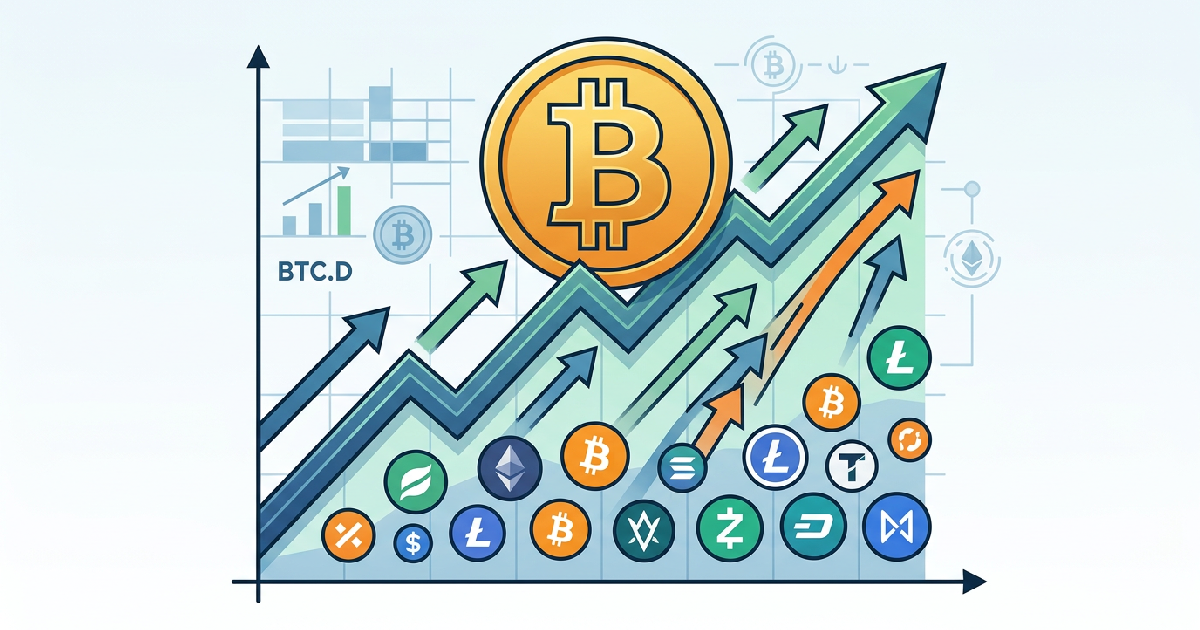
Bitcoin dominance (BTC.D) remains a vital metric for digital asset investors on June 14, 2026, as it dictates the flow of capital and the relative strength of the broader cryptocurrency market.
This percentage, which represents Bitcoin’s share of the total market capitalization, serves as a primary indicator of whether investors are seeking safety in the largest asset or taking risks in alternative coins. Recent market data shows that fluctuations in this ratio directly influence the performance of altcoins like Ethereum, Solana, and Litecoin.
When Bitcoin dominance rises, it generally reflects a “flight to safety” where capital is pulled from riskier assets and consolidated into Bitcoin. This often results in altcoins underperforming or experiencing price declines relative to the market leader. Conversely, a falling dominance often signals an increased risk appetite among traders, suggesting that capital is rotating out of Bitcoin and into altcoins.
Understanding these shifts requires looking at how market cycles evolve. In early bull markets, Bitcoin frequently leads the recovery, causing its dominance to increase. As these cycles mature and Bitcoin maintains its gains, investors often rotate profits into larger altcoins in search of higher percentage returns. This shift is what typically triggers a broader rally for the thousands of other tokens in the ecosystem.
Mechanisms behind Bitcoin dominance and capital rotation
The calculation of Bitcoin dominance is straightforward but powerful. It is the Bitcoin market capitalization divided by the total crypto market capitalization, multiplied by 100. Traders use platforms like TradingView and CoinGecko to track this percentage in real-time, often looking for specific psychological thresholds that historically dictate market behavior.
Market cycles usually follow a predictable liquidity path. Money often flows from fiat currency into Bitcoin first, then moves to large-cap altcoins, and finally trickles down to smaller-cap assets. This rotation happens because Bitcoin is the most liquid entry point for institutional capital and is widely perceived as “digital gold,” a long-term store of value during times of macroeconomic uncertainty.
A sharp decline in dominance is often viewed by analysts as a prerequisite for an altcoin season. Specifically, when the BTC.D percentage falls below certain psychological thresholds like 50% or 40%, it indicates that altcoins are collectively outperforming Bitcoin.
However, it is important to check these figures against total market cap trends to ensure the shift isn’t just a result of Bitcoin losing value faster than the rest of the market.
Market scenarios and dominance trends
| Market Scenario | BTC Dominance Trend | Altcoin Performance Relative to BTC |
|---|---|---|
| Early Bull Market / Recovery | Rising | Underperforming (Capital flows to BTC) |
| Maturing Bull Market | Falling | Outperforming (Profits rotate from BTC) |
| Bear Market / Uncertainty | Rising | Declining significantly (Flight to safety) |
| Bitcoin Consolidation | Falling | Rallying (Stable BTC allows alt growth) |
Technological innovation as a driver of market share
While Bitcoin remains the dominant force, the emergence of innovative technologies in the altcoin space constantly challenges its market share. Assets that offer smart contracts, decentralized finance (DeFi), or faster transaction speeds attract independent capital. According to protocols tracked by CoinMarketCap, these technological advancements create unique utility that can decouple specific altcoins from Bitcoin’s immediate price action.
Regulatory environments also play a major role in these dynamics. Supportive regulations can bolster Bitcoin’s status as a primary institutional asset, helping it maintain a high dominance level. On the other hand, hostile regulations or sudden shifts in investor sentiment can lead to capital exiting the top asset, even if that capital doesn’t necessarily enter altcoins immediately.
Some analysts now prefer to monitor “real Bitcoin dominance.” This version of the metric excludes stablecoins from the total market capitalization. By removing dollar-pegged tokens like USDT and USDC from the equation, traders get a much clearer picture of how speculative capital is moving between Bitcoin and active altcoins, rather than just seeing capital sitting on the sidelines.
Psychological benchmarks and long-term projections
In the early days of the industry, Bitcoin held nearly 100% of the market share. However, as the ecosystem expanded, its dominance reached a historical low of approximately 35% during the 2017 ICO boom. Since then, the market has settled into a more predictable rhythm with key psychological levels observed at 40%, 50%, 60%, and 70%.
In today’s market, industry experts generally project that Bitcoin dominance will stabilize within a 40% to 60% range over the next decade. While cyclical swings will continue to occur, the growth of alternative platform technologies makes a return to 90% dominance unlikely. These ranges help traders identify when the market is potentially over-extended in one direction or the other.
It is a common error to assume that falling dominance always means a bull market for altcoins. Dominance can fall if Bitcoin’s price is decreasing but altcoins are falling more slowly. Therefore, the ratio must be used in conjunction with individual asset performance. A rise in dominance during a bear market usually highlights that altcoins are suffering disproportionately larger losses than the market leader.
Frequently Asked Questions
Does a decline in Bitcoin dominance always mean altcoins are rising?
No. A decline in dominance simply means Bitcoin is losing market share relative to other assets. This can happen if altcoins are rising faster than Bitcoin, but it can also occur if Bitcoin’s price is falling more rapidly than altcoin prices during a market-wide downturn.
What are the most common psychological levels for BTC dominance?
The most widely watched psychological levels for Bitcoin dominance are 40%, 50%, 60%, and 70%. A sharp move below the 50% or 40% thresholds is frequently interpreted by traders as a primary signal that a collective altcoin rally, or altcoin season, has begun.
How do technological advancements in altcoins affect Bitcoin’s market share?
Technological innovations such as smart contracts, decentralized finance (DeFi), and increased transaction speeds can attract investor capital away from Bitcoin. As these alternative assets gain utility and value, they increase their share of the total crypto market cap, thereby applying downward pressure on Bitcoin’s dominance percentage.