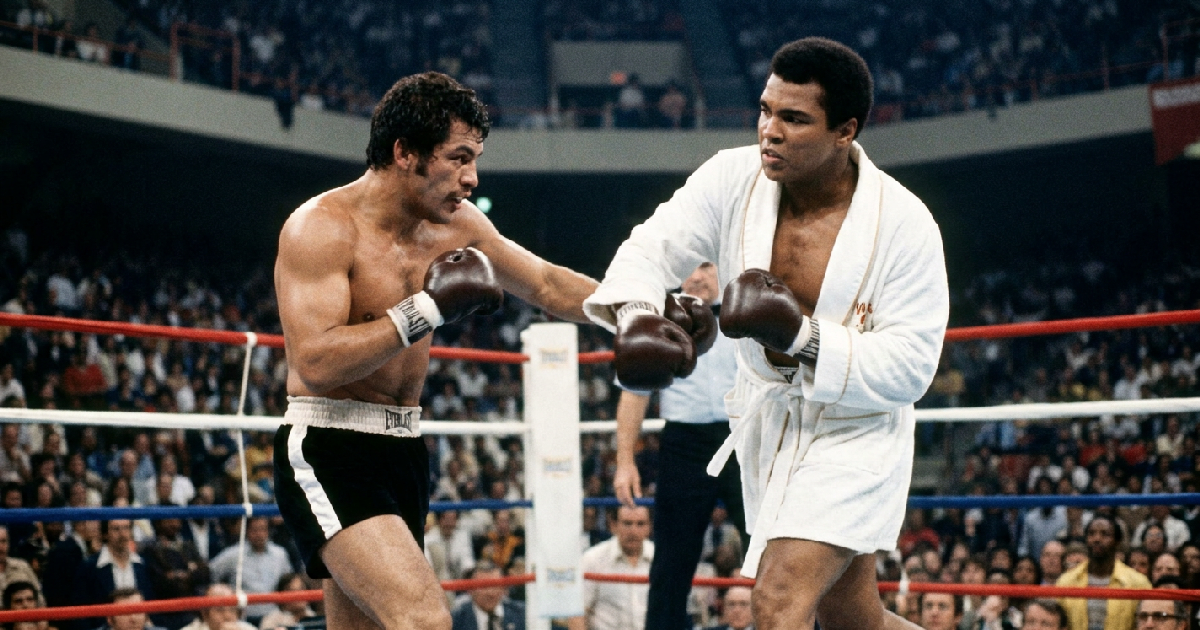
The history of the heavyweight division is often defined by the twilight years of its greatest legends, where veteran savvy begins to face off against the raw energy of youth. Late in the 1970s, Muhammad Ali found himself in a defensive position that would eventually become a recurring theme in the later stages of his career. During a recorded title defense in Landover, Maryland, he faced the Uruguay-born challenger Alfredo Evangelista in a contest that tested the champion’s traditional dominance against a younger, durable opponent.
Reports from the era describe the event at the Capitol Centre as an illustration of how the world’s most famous athlete had begun to transition his style. No longer the fleet-footed “butterfly” of the 1960s, the champion reportedly relied more on his jab and ring generalship to control the pace of the fight. Alfredo Evangelista, who had established a reputation for toughness in Europe, entered the ring as an underdog but reportedly managed to frustrate the champion by refusing to succumb to the psychological and physical pressure Ali was known for exerting.
Analysis of the Maryland Heavyweight Contest
The bout reportedly stretched the full scheduled distance, a result that surprised many contemporary observers who had expected a more rapid finish. Throughout the rounds, Alfredo Evangelista was noted for his persistence, despite the champion’s clear advantage in experience and technical execution. Accounts of the fight suggest that while the champion controlled the majority of the action, the absence of a decisive stoppage led to immediate post-fight discussions regarding the natural decline of his speed and power.
Much like how Oleksandr Usyk keeps the Tyson Fury rivalry alive in today’s landscape through tactical intelligence, the champion in the late 70s used his boxing IQ to outmaneuver a younger challenger. This specific defense was part of a larger, final chapter in a reign that had seen the belt defended multiple times across several continents. Critics at the time pointed out that the accumulation of tough rounds, such as those endured in Maryland, was beginning to manifest in the champion’s slower reflexes.
Refining the Champion’s Late-Career Strategy
By the time the final bell sounded, the general consensus was that the champion’s fundamental skills remained intact even as his physical gifts began to wane. This period was marked by more deliberate performances, moving away from the high-energy displays of his youth. The boxing world often reflects on this era when discussing the longevity of modern fighters, especially as concerns regarding health and timing often dictate the end of a career.
In contemporary discussions, the question of when a fighter should step away remains a fixture of the sport. For instance, reports regarding how the Jake Paul boxing career is facing a potential end due to health evaluations mirror the historic concern for icons who continued to compete against younger prospects like Alfredo Evangelista. The fight served as a reminder that championship mettle can sometimes bridge the gap between a fighter’s prime and their physical decline.
The Legacy of 1970s Heavyweight Boxing
While the encounter with Alfredo Evangelista is often overshadowed by the champion’s more legendary trilogies, it is cited as a significant moment in the sport’s administrative history. It was one of the final instances of a single, unified king ruling the division before the modern era of multiple sanctioning bodies took full effect. Information preserved by the International Boxing Hall of Fame highlights how the champion’s consistency during this era provided a blueprint for how a heavyweight can maintain a title reign well into their thirties.
The event also marked a period of high visibility for boxing on broadcast television, reaching massive audiences eager to see the “Greatest” in action. Alfredo Evangelista, despite the reported outcome of the bout, used the performance to solidify his standing in the division. He eventually moved on to face other major figures of the era, proving that his durability in Maryland was not a one-time occurrence.
Historical Comparisons to Modern Heavyweight Shifts
The frequency of title defenses in the 1970s stands in contrast to the fragmented and often delayed schedules of the 21st century. In that era, champions were expected to be highly active, often taking on diverse challengers in rapid succession. This differs significantly from the current climate, where Daniel Dubois prepares for his Fabio Wardley encounter as part of a more modern, paced progression toward the top of the rankings.
The records of this title defense remain a poignant part of boxing’s historical archive. Documentation from the Cumberland Times-News has long served as a primary source for the regional impact of the Maryland bout. It remains a testament to an era where the heavyweight crown was the central focus of the sporting world, held by a figure whose influence extended far beyond the ropes of the ring.