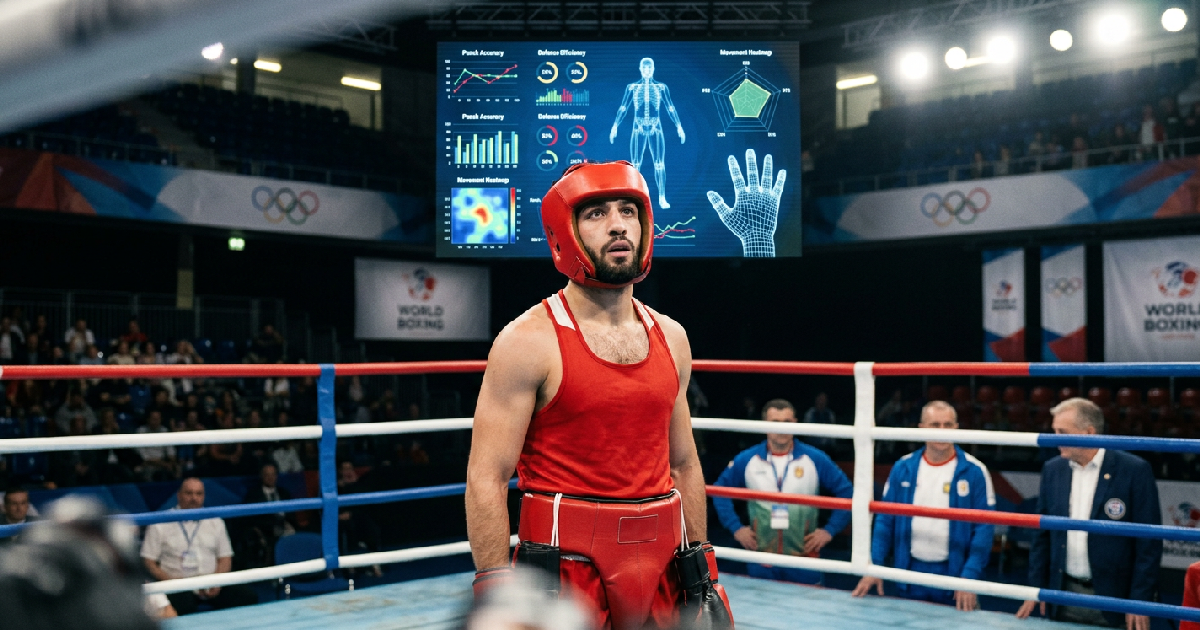
World Boxing, the new international governing body for amateur boxing, is developing an Artificial Intelligence pilot project to overhaul the sport’s scoring and restore protective headgear. Reported on May 23, 2026, by Qazinform, the initiative aims to safeguard Olympic boxing’s integrity ahead of the 2028 Los Angeles Olympics. By introducing objectivity into bout reviews, the federation hopes to ensure that official results reflect the performance of the best athlete in every contest.
The proposed changes address long-standing controversies surrounding human bias in judging and refereeing. According to Alimzhan Akaev, Vice-President of the Kazakhstan Boxing Federation for International Affairs, the systems will count the number of punches, accurate hits, and their power. This move mirrors interest in high-level data across the sport, such as the punch count comparisons used to analyze major heavyweight bouts. World Boxing plans to integrate this technology into competitions by the end of 2026 or early 2027.
The International Olympic Committee (IOC) is also involved, partnering with SWA to pilot AI-powered judging. This system uses data capture to provide transparent, explicable scoring breakdowns during and after rounds. IOC President Thomas Bach stated that AI can help reduce human bias, a critical step for a sport that has faced governance challenges. This objective data provides a technical foundation that could support disciplined fight strategies by giving coaches and athletes detailed post-fight analysis to review performance.
Advanced technology and the pilot for Olympic boxing integrity
World Boxing President Boris Van Der Vorst emphasized that modern technology is essential to restore the trust of fans, boxers, and coaches. The federation is currently piloting a transparent bout review system with various AI providers. The goal is to minimize the influence of the human factor, which has historically led to disputed decisions. Van Der Vorst acknowledged that maintaining competition integrity is the main challenge for gaining full recognition from the IOC.
The technology works by training AI on historical fight data and scoring patterns to replicate human judging without subjective errors. During the pilot phases, which included the Paris Olympic Games and qualifiers, the system delivered consistent decisions. It provides tested scoring breakdowns that explain exactly why a fight was scored in a particular way. This transparency is intended to eliminate the “black box” nature of current scoring systems that often frustrate participants.
Lessons from China’s BoxMind and historical AI use
Recent major tournaments have already seen the introduction of AI in various capacities. At the 2024 Paris Olympics, China utilized an AI system called BoxMind specifically to provide tactical recommendations to coaches between rounds. The tool analyzed 18 indicators in real-time and reportedly had an 87.5% accuracy rate in predicting winners. During those Games, the Chinese boxing team was highly successful, securing 3 gold and 2 silver medals.
Previous efforts to modernize the sport through technology include the International Boxing Association (AIBA) using AI in 2021 to vet officials. That system analyzed cognitive functions in verbal responses to grade judges on a risk scale. Regarding that specific 2021 initiative, American boxing legend Roy Jones Jr. remarked that it would have been “very beautiful” to have had such technology in his era, noting it was “better late than never.”
Restoring protective headgear for athlete safety
Alongside the digital scoring revolution, World Boxing intends to reintroduce protective headgear for athletes. The federation plans to implement this change starting in late 2026 or from the beginning of 2027. While headgear was previously removed for certain divisions, the new governing body views its restoration as a key component of athlete protection and long-term health. The reintroduction of this gear is part of a broader safety mandate that aligns with the IOC’s hygiene and welfare standards.
The return to headgear occurs as the sport faces increased scrutiny over athlete health news and safety protocols across all levels. World Boxing is positioning itself as a reform-minded organization capable of modernizing the amateur ranks. By combining physical protection with technological transparency, the body aims to present a stabilized version of boxing for inclusion in future Olympic cycles after 2024.
Frequently Asked Questions
When will the new AI judging system be implemented?
World Boxing plans to introduce the AI system into the competitive process by the end of 2026 or in early 2027. The organization hopes the technology will be fully matured and functional by the time the 2028 Los Angeles Olympics begin.
What specific data will the AI judging tool track?
The AI system is designed to count the total number of punches thrown, the number of accurate hits that land on target, and the power behind those strikes. This data will be used as an additional tool to minimize human bias and ensure objective scoring during bout reviews.
Is headgear returning to Olympic-style boxing?
Yes, World Boxing has announced plans to reintroduce headgear for athlete protection. This change is expected to take effect by the end of 2026 or from the beginning of 2027 as part of a commitment to enhancing safety and meeting IOC requirements.