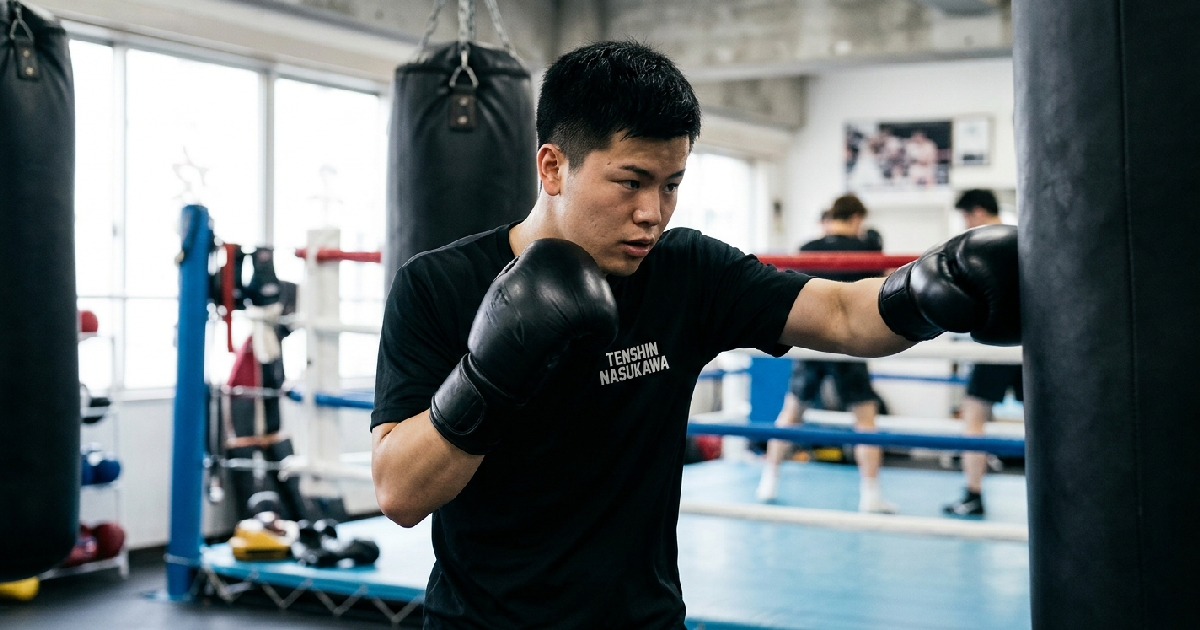
Tenshin Nasukawa is evolving. The former kickboxing standout, now fully immersed in his professional boxing journey, has recently shown a different side of both his personality and tactical approach. Observers of the Japanese star have noted a shift in his demeanor, moving away from the flashy, talkative persona that defined his early career toward a more stoic and calculating presence in the ring.
Those close to the camp have reportedly noticed a distinct change in how Nasukawa carries himself leading up to his bouts. There is a newfound quietness that wasn’t previously a hallmark of his character. While fans were once used to a fighter who constantly engaged with the media and maintained high-energy public appearances, they are now seeing a man who appears to have found a deeper level of focus. This shift seems to reflect the intense technical overhaul required to transition from the world of kickboxing to the elite levels of professional boxing.
Overcoming the kickboxing blueprint
The transition between disciplines is notoriously difficult, even for a talent as natural as Nasukawa. A primary hurdle involves unlearning established rhythms; kickboxers often maintain an upright stance and rely on explosive bursts that utilize a different weight distribution. Reports suggest Nasukawa has spent significant time meticulously adjusting his center of gravity, learning how to sit on his punches rather than relying on the snapping strikes typical of his former sport.
This technical evolution has become increasingly evident in his ring craft. By focusing on a body-snatching style and improving his inside game, Nasukawa is addressing one of the most common weaknesses for converted kickboxers. The ability to generate power at close range without the option of using knees or clinching is a specific boxing skill that requires years to master. While Nasukawa continues his ascent, the global boxing scene remains in flux, with some fighters choosing to step away while others just begin their journey. This is a common cycle in the sport, much like how Delicious Orie ends boxing career paths to pursue new professional opportunities outside the ring.
The psychological weight of the transition
The perceived change in Nasukawa’s personality is likely tied to the mounting pressure of the bantamweight division. In his previous discipline, he was a dominant force often facing opponents who struggled with his unique speed. In boxing, the margin for error is significantly smaller, and the depth of talent at the world level offers a much steeper challenge. Every mistake in the ring carries a heavier price, particularly when moving toward world-ranked opposition.
There is also the matter of professional legacy. Nasukawa is not just fighting for wins; he is attempting to prove that his striking pedigree can translate into a world title. This ambition has seemingly turned him inward. What some Japanese media outlets describe as an “unusual change” may simply be the silence of a dedicated athlete realizing the complexity of the sport. He has reportedly pivot away from verbal bravado, instead letting his defensive positioning and improved jab speak for his progress.
Modern boxing is constantly evaluating these themes of career longevity and adaptation. Questions frequently arise regarding the physical toll on athletes and how they modify their styles to stay competitive, as boxing retirement age safety remains a persistent topic within the industry. For a fighter in his physical prime, this technical renaissance is coming at a critical juncture.
Strategic growth and world title aspirations
What makes the recent phase of Nasukawa’s career so compelling is the reduction of “wasted” movement. Earlier in his boxing appearances, he frequently used his legs to reset after every exchange—a habit developed to avoid low kicks. Current reports indicate he is showing a better ability to stay in the pocket, parrying shots and searching for counters. His recent success in breaking down opponents is often cited by analysts as evidence of this newfound efficiency.
His team has apparently been rigorous in scouting and identifying “kickboxing flaws,” such as a tendency to lead with the head or a lack of a consistent, stiff jab. By narrowing his focus to the mechanical nuances of the sport, Nasukawa is positioning himself as a legitimate factor in the 118-pound division. The road ahead will inevitably involve a significant step up in quality. As he nears potential world title opportunities, the scrutiny of his performances will only intensify.
We have seen other elite practitioners maintain their status through similar shifts in tactical focus and mental preparation, a necessity in high-stakes bouts where Caroline Dubois defeats Terri Harper or similar rivals in matches that demand absolute concentration. Nasukawa appears ready to join those who prioritize clinical execution over charisma. His current path suggests that the loudest statements in boxing are made with the gloves, and for the former kickboxing star, the path to the top is becoming increasingly defined.