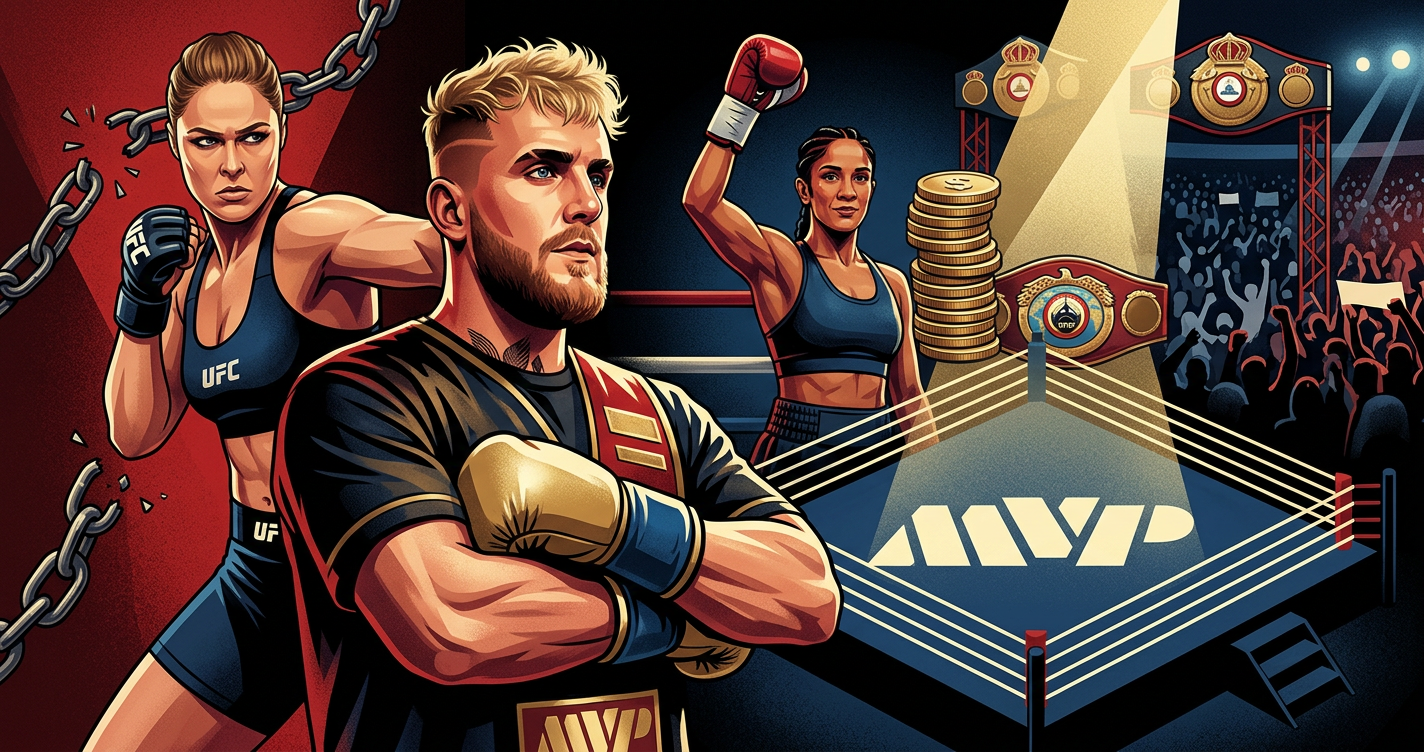
Jake Paul has built a reputation on disrupting the status quo in combat sports, but his latest venture suggests a pivot toward long-term advocacy rather than just short-term pay-per-view numbers. The YouTuber-turned-prizefighter recently detailed how watching Ronda Rousey’s ascent in the UFC served as the blueprint for his current dedication to advancing women’s boxing.
Paul’s influence in the ring is often debated, but his impact on the business of the sport increasingly centers on the female side of the ledger. Through his promotional company, Most Valuable Promotions (MVP), Paul has spent the last few years positioning elite female fighters like Amanda Serrano at the top of major cards, demanding pay parity and exposure that was previously elusive in a male-dominated industry.
The Rousey Influence and the Market Gap
The inspiration for this shift didn’t come from the history books of boxing, but from the Octagon. Paul has pointed to Ronda Rousey’s era of dominance in the mid-2010s as a lightbulb moment. Rousey didn’t just win; she became the biggest draw in the UFC, consistently out-selling her male counterparts and proving that gender was no barrier to commercial viability if the marketing was right.
For Paul, the lesson was simple: women’s sports are an undervalued asset. While the UFC eventually embraced women’s divisions because of Rousey’s undeniable magnetism, boxing had been slower to move. Paul saw a vacuum. By applying the same digital-first promotion style that built his own brand, he realized he could elevate women’s boxing from the “curtain-raiser” slot to the main event.
He isn’t just an observer in this space. Since signing Amanda Serrano, Paul has facilitated some of the biggest moments in the sport’s history, including the historic sell-out at Madison Square Garden for Serrano’s bout against Katie Taylor. That fight wasn’t just a win for the athletes; it was a proof of concept for Paul’s theory that the “Rousey effect” could be replicated in the ring.
Shifting the Financial Paradigm
But promotion is only half the battle. The real challenge in women’s boxing has always been the purse. Paul has been vocal about the disparity in pay, often using his platform to pressure other promoters to increase their offerings. He’s argued that if a fighter like Rousey could command millions in the UFC, there is no reason the pound-for-pound queens of boxing should be fighting for fractions of that amount.
And it’s working. By placing female fighters in co-main event slots on high-profile cards, Paul is forcing broadcasters and sponsors to take notice. He has frequently sat out of his own show’s spotlight to ensure the focus remains on the talent he represents. This isn’t just altruism; it’s a calculated business move. As the “influencer boxing” bubble faces its inevitable peaks and valleys, a stable of world-class female champions provides a level of legitimacy and longevity that YouTube rivalries cannot match.
Impact on the Future of the Sport
The ripple effect is being felt across the industry. We are seeing more multi-fight deals for women and a greater emphasis on “super-fights” that fans actually want to see. The success of the MVP model has forced rival promotional powerhouses to rethink their approach to female talent.
Critics often point to Paul’s own boxing credentials with skepticism, yet even his harshest detractors find it difficult to argue with his results as a promoter. He has successfully bridged the gap between the casual “Gen Z” audience and the hardcore boxing community using women’s bouts as the primary vehicle for that connection.
So, where does the sport go from here? The focus is now on depth. While stars like Serrano and Taylor have paved the way, the next step is building out a full ecosystem where up-and-coming female fighters have a clear path to a living wage and mainstream recognition. Paul’s goal seems to be creating a world where a female fighter doesn’t need to be a “once-in-a-generation” talent like Rousey to get a fair shake.
The road ahead is still long, and boxing’s institutional hurdles are famously high. But by channeling the energy that once made Ronda Rousey a household name, Jake Paul is ensuring that the conversation around women’s boxing is no longer about whether they belong on the big stage, but how soon they can take it over entirely.