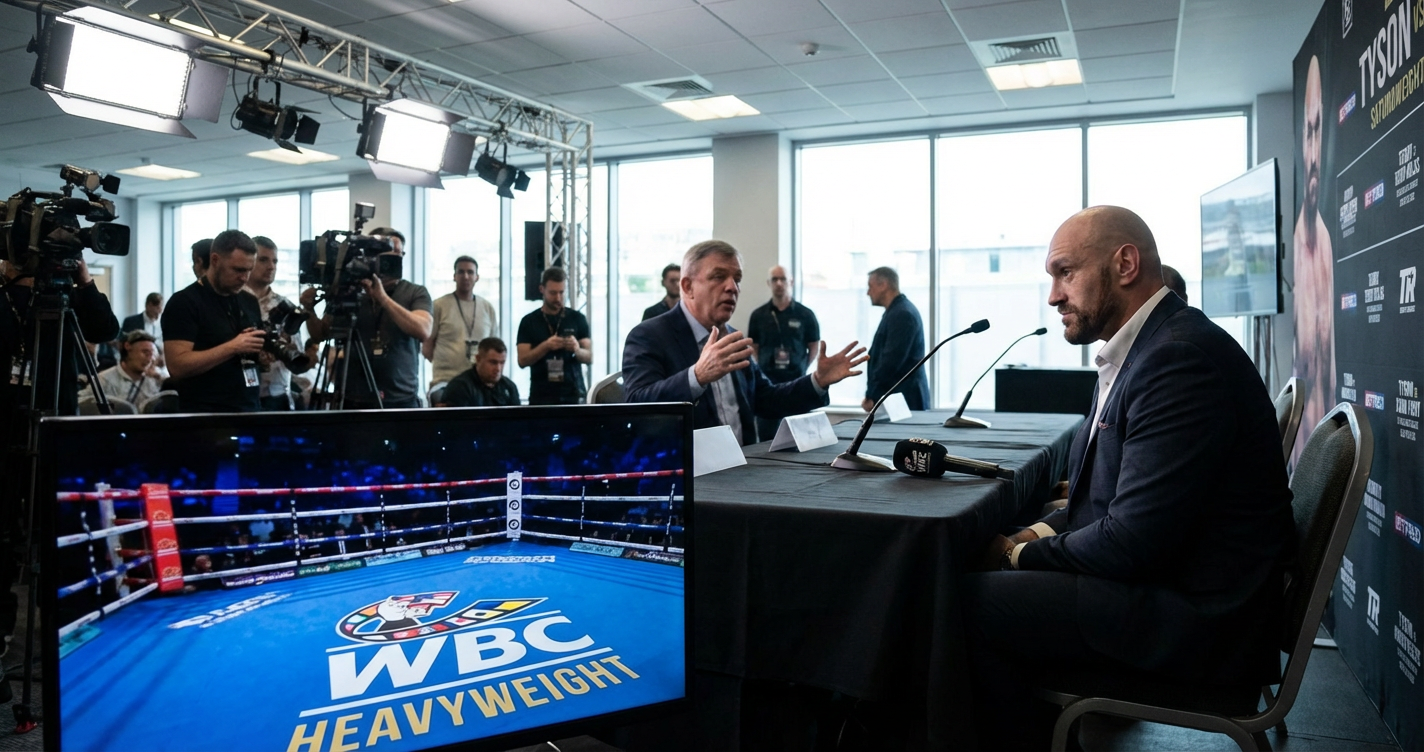
Teddy Atlas has never been one to bite his tongue when it comes to the technical shortcomings of modern heavyweights, and his latest critique focuses squarely on WBC champion Tyson Fury. As the countdown to Saturday’s high-stakes encounter intensifies, Atlas has voiced concerns regarding Fury’s recent activity levels and the physical toll of his long career.
The veteran trainer and analyst, speaking on his recent podcast, suggested that the version of Fury who outclassed Deontay Wilder may be fading. Atlas pointed to the “Gypsy King’s” recent outings—including the narrow decision victory over Francis Ngannou—as evidence that his work rate and defensive reflexes might be showing signs of regression.
The Ngannou Shadow and Training Camp Rumors
For most observers, the performance against Ngannou served as a warning light. Atlas argues that such a performance isn’t just a “bad night at the office” but a symptom of a fighter who is finding it harder to pull the trigger. In a sport where timing is everything, Atlas believes Fury is starting to rely more on his size and wrestling tactics than the fluid movement that once defined his reign.
There have also been whispers surrounding Fury’s preparation. While his camp has released footage of a lean, conditioned champion, Atlas remains skeptical about whether the intensity remains. “It’s about what happens in the tenth round when the lungs are burning,” Atlas noted. He emphasized that Fury’s ability to maintain a high volume of punches has historically been his greatest weapon against smaller, faster opponents.
And yet, the contradiction of Tyson Fury remains his greatest strength. He has built a career on defying expectations and recovering from the brink of defeat. But Atlas suggests that relying on “old reliable” attributes like a sturdy chin and sheer willpower becomes a dangerous game as a fighter enters his mid-30s.
Tactical Regressions and Physical Toll
The critique from Atlas isn’t merely about fitness; it’s about tactical discipline. He observed that Fury has become increasingly stationary in his recent fights. By planting his feet more often, Fury becomes a bigger target for the precise, clinical combinations that his upcoming opponent is known to throw. If the work rate drops, Fury loses the ability to “stifle” the fight—a tactic he uses to reset the pace when he feels under pressure.
Boxing historians often point to the “cliff” that heavyweights hit. Unlike lower weight classes where speed goes first, heavyweights often lose their “engine”—the ability to sustain three minutes of active work per round. Atlas’s main contention is that if Fury cannot throw 40 to 50 punches a round to keep his opponent at bay, he will be forced into a firelight he might not be equipped to win at this stage of his life.
The Stakes on Saturday
Expectations for Saturday are polarized. To his supporters, Fury is the natural “A-side” whose reach and ring IQ will eventually solve any puzzle put in front of him. To skeptics like Atlas, he is a champion fighting against the clock as much as his opponent.
The heavy weight of expectation carries a different kind of pressure this time. This isn’t just about a belt; it’s about the legacy of an era. If the work rate issues Atlas highlighted prove true, the heavyweight division could see its first major shake-up in years. Conversely, a vintage “long-range” performance from Fury would silence his loudest critics and set up a historic run toward undisputed status.
For those watching the scales and the ring walks, the focus will be on Fury’s body language in the opening three rounds. If he is feinting, moving his head, and pumping a consistent jab, then the concerns may be premature. But if he is looking to clinch early and appears heavy-legged, the Atlas prediction might look increasingly prophetic as the fight enters the championship rounds.