The lights never seem to grow dim enough for some of boxing’s greatest names to take the hint. While most professional athletes find themselves comfortably retired by their late 30s, the ring remains a persistent siren song for those who have spent their lives inside it. In a sport where the margins of safety are measured in split-second reactions, the ambiguity surrounding “retirement age” has become a growing concern for regulators and fans alike.
Every decade or so, boxing faces a reckoning with its own mortality. We saw it when Larry Holmes tried to solve the puzzle of a young Mike Tyson, and again when Roy Jones Jr. continued to lace up gloves long after his superhuman reflexes had evaporated. But the current era has blurred the lines further, as lucrative exhibition bouts and the “crossover” era have turned aged legends into viable commercial assets once again.
The medical reality versus the promotional machine
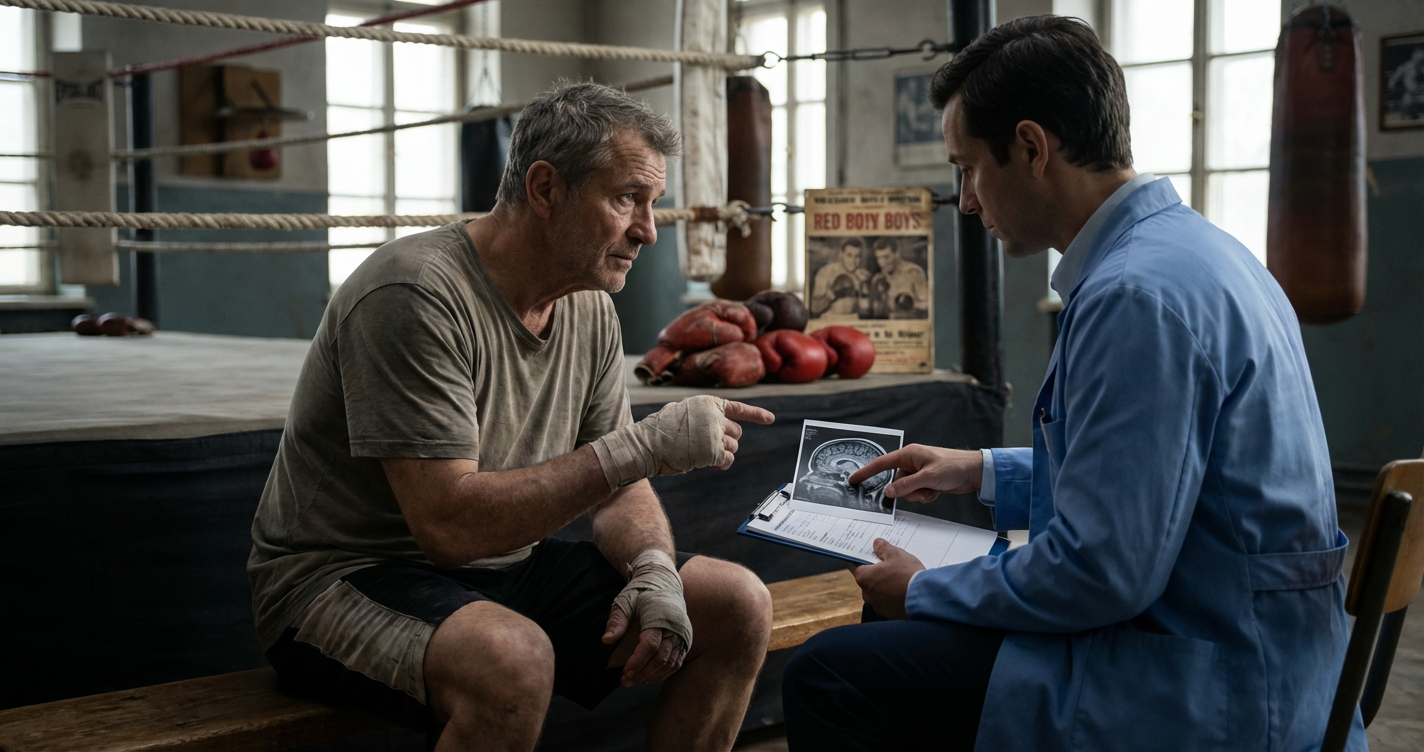
Physically, the data on aging is unforgiving. Neurologists have long warned that the ability of the brain to withstand concussive force diminishes with age. The protective fluid surrounding the brain thins, and the recovery time for micro-traumas lengthens. Yet, a boxer’s “fighting age” is often distinct from their chronological age. A 40-year-old who has lived cleanly and avoided “wars” might theoretically be fresher than a 30-year-old who has been through dozens of bruising encounters.
Sanctioning bodies and state commissions remain the primary gatekeepers, but their standards vary wildly. In some jurisdictions, a fighter over 35 is required to undergo more rigorous neurological testing, including MRIs and stress tests. In others, a legendary name is often enough to bypass the more stringent hurdles. The problem is that these tests can measure current health, but they cannot predict how a veteran’s chin will hold up against a punch they would have slipped ten years ago.
And then there is the money. Promoters know that a recognizable 45-year-old name often sells more tickets than a technically superior 23-year-old prospect. When nostalgia becomes a revenue stream, the incentive to protect a fighter from themselves often takes a backseat to the bottom line.
When the comeback trail leads to a dead end
The history of the sport is littered with cautionary tales. For every Bernard Hopkins, who defied biology to win world titles into his late 40s, there are dozens of fighters who stayed one fight too long. The danger isn’t just a loss of dignity or a tarnished legacy; it’s the cumulative damage that often doesn’t manifest until years after the final bell.
Modern training methods have certainly extended careers. Better nutrition, advanced recovery techniques, and a more scientific approach to “tapering” allow fighters to maintain their physical conditioning well into their 40s. But conditioning and “punch resistance” are two different things. You can have the physique of a Greek god at 42, but your central nervous system doesn’t care how many miles you ran or how many vegetables you ate.
The rise of high-profile exhibitions has complicated the “too old” debate. These bouts are often billed as “safe” alternatives to professional fighting, yet they still involve heavy-hitting professionals trading blows. The line between a sparring session with an audience and a real fight is perilously thin, and it only takes one misplaced shot to turn an exhibition into a tragedy.
The search for a universal standard
Calls for a universal retirement age in boxing have consistently failed to gain traction. Critics argue that a hard cap would be discriminatory and would have robbed fans of some of the sport’s most historic moments. If a 40-year-old George Foreman had been forced into retirement, we never would have seen his miraculous knockout of Michael Moorer.
Instead of a chronological age limit, some advocates are pushing for a “performance-based” exit strategy. This would involve mandatory retirement for fighters who have lost a certain number of bouts in a row by knockout, or for those whose cognitive testing shows even a slight deviation from their baseline. But the implementation of such a system requires a level of global cooperation that boxing has historically lacked.
As we see more veterans returning to the ring, driven by either a lack of post-career financial stability or the simple inability to walk away from the roar of the crowd, the sport remains in a state of precarious indecision. Boxing doesn’t have a season, and apparently, for some of its biggest stars, it doesn’t have an expiration date either.
A culture of enablement
Inside the gym, the people closest to the fighters are often the least likely to tell them it’s over. Trainers and managers have a vested interest in the next payday, and “yes men” are a perennial fixture in every major camp. It often falls to the family or the media to ring the alarm, but by the time the public notices the slurred speech or the slowed gait, the damage is usually done.
For now, the responsibility lies with the individual commissions to act as the adults in the room. They are the only ones with the legal power to pull a license and save a fighter from their own competitive instincts. Until a unified standard is adopted, the question of “how old is too old” will continue to be answered on a case-by-case basis—often with heartbreaking results.