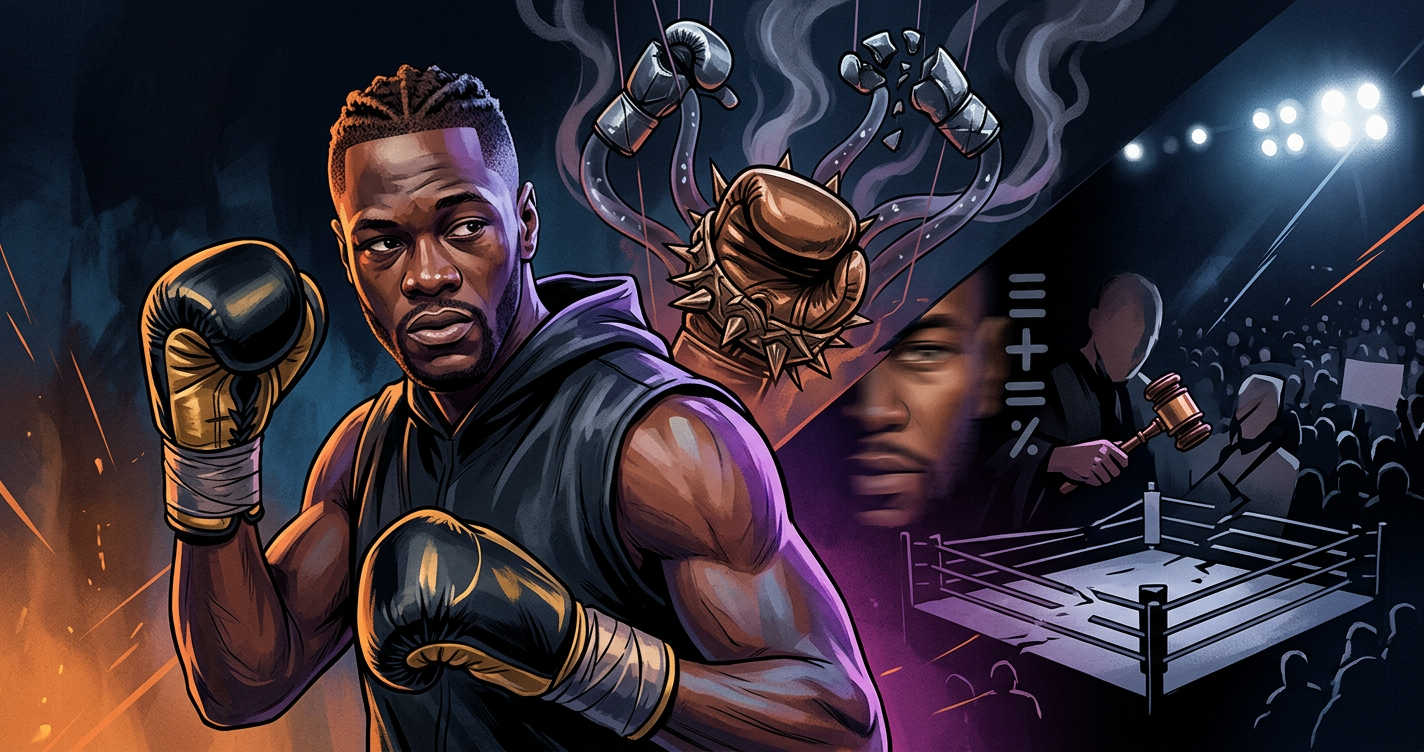
Deontay Wilder is rarely one to hold his tongue, but his latest broadside against the boxing establishment suggests a fighter who feels he is fighting a war on two fronts: one in the ring and one against the industry itself. In a recent series of pointed remarks, the former WBC heavyweight champion took aim at what he describes as a culture of deception, warning fans that the narratives they consume are often carefully crafted illusions.
Wilder, known as “The Bronze Bomber,” has spent the better part of a decade as one of the sport’s most polarizing and bankable stars. Yet, despite his high profile, he has frequently positioned himself as an outsider. This latest outburst follows a period of professional turbulence, where the heavy-hitting Alabamian has struggled to regain the momentum that saw him hold the green belt for five years.
The machinery behind the curtain
Wilder’s frustrations appear to stem from the opaque nature of high-level negotiations and the way certain fighters are presented to the public. He claimed that the industry is rife with manipulation, suggesting that promoters and power brokers are “lying” to the audience to protect their assets and manage public perception.
It’s a sentiment that resonates with a segment of the boxing world often frustrated by the long delays in making the sport’s biggest fights. While fans demand undisputed matchups, the reality is often a tangle of step-apart fees, broadcasting rights disputes, and promotional rivalry. Wilder’s argument is that these hurdles are frequently used as excuses to shield “protected” fighters from genuine risks.
But there is also a personal edge to his claims. Since his trilogy with Tyson Fury and a subsequent loss to Joseph Parker, Wilder has seen his status in the divisional hierarchy questioned. By framing the industry as a manipulative entity, he is also defending his own legacy, implying that his setbacks and the difficulties in securing certain opponents are part of a broader systemic issue rather than a decline in his own prowess.
A history of outspoken skepticism
This isn’t the first time Wilder has leveled serious accusations at the sport. Following his second loss to Tyson Fury, he famously alleged everything from spiked water to heavy walk-out costumes played a role in his defeat. While those claims were met with widespread skepticism, his current grievances focus more on the business of the sport than “conspiracies” in the ring.
The heavyweight division is currently at a crossroads. With the influx of Saudi Arabian investment, many of the traditional barriers to big fights have been swept aside by sheer financial force. However, Wilder seems to believe that even with more frequent high-stakes matchups, the underlying “manipulation” of the rankings and the narrative remains unchanged.
He isn’t alone in this frustration. Many fighters have complained about the “alphabet soup” of sanctioning bodies and the seemingly arbitrary way mandatory challengers are appointed. But Wilder’s platform allows these complaints to reach a much wider audience, forcing a conversation about transparency that the sport’s suits often prefer to avoid.
What lies ahead for The Bronze Bomber
If Wilder truly believes he is fighting against a rigged system, the question remains how he intends to navigate it in the twilight of his career. At 38, the clock is ticking. His devastating right hand remains the great equalizer, but his recent performances have shown a fighter who can be outboxed if the big shot doesn’t land.
To prove his point, Wilder needs more than rhetoric; he needs a high-profile win. Talking about being manipulated only carries weight if the fighter remains a viable threat at the top of the division. If he can secure and win a major fight, his claims of being “blackballed” or “lied about” will gain significant traction.
For now, the boxing world is left to parse his warnings. Whether this is a genuine cry for reform or a veteran fighter lashing out at a sport that is moving on without him remains to be seen. What is clear is that Wilder has no intention of going quietly into the night, and his willingness to burn bridges might be exactly what keeps him in the headlines as he plots his next move.